
What's in this walkthrough
- Before you start
- Step 1: Know your options
- Step 2: Choose the destination account
- Step 3: Open the receiving account
- Step 4: Request a direct rollover
- Step 5: Choose your investments once it lands
- Step 6: Confirm it posted and handle the tax paperwork
- Your 401(k) options, ranked
- IRA vs 401(k): which should hold your money
- Rollover vs cash-out: where your money goes
- Why cashing out costs far more than it looks
- A worked example: rolling over 50,000 dollars
- Common mistakes to avoid
- Troubleshooting and edge cases
- Your 401(k) rollover checklist
- The bottom line
Short answer: To roll over a 401(k) without a penalty, choose a destination, usually an IRA or your new employer's plan, open that account, then ask your old plan administrator for a direct, trustee-to-trustee rollover so the money moves institution to institution and never passes through your hands. That sidesteps the 60-day deadline and the mandatory withholding trap. Once the money lands, invest it rather than leaving it in cash.
Rolling over an old 401(k) is one of those financial chores that feels risky enough to keep postponing, so millions of accounts sit forgotten at former employers, or worse, get cashed out in a moment of convenience that quietly costs tens of thousands of dollars. The task itself is not hard. The danger is entirely in the method: move the money the right way and it stays sheltered, keeps compounding, and never generates a tax bill; move it the wrong way and you can hand over a third of it to taxes and penalties before you realize what happened. This worksheet lays out the safe path in six ordered steps.
By the end you will know your four real options and why cashing out is almost never one of them, how to pick a destination account, how to open it, and, most importantly, how to request a direct rollover so the money never touches your hands and never triggers the 60-day trap. Every dollar figure and tax rate here is illustrative, chosen to show the shape of the math rather than to state your exact result, and tax rules change over time, so confirm the current figures before you act. If you want the bigger picture on where this account fits, our walkthrough on how much to have in a 401(k) by age sets the benchmark, and you can test any balance in the calculator as you read.
Key takeaways
- A rollover moves your old 401(k) into another tax-advantaged account (usually an IRA or a new 401(k)) without taxes or penalties, as long as you use the right method.
- Always request a direct, trustee-to-trustee rollover so the money moves institution to institution and never passes through you, which sidesteps the 60-day deadline and the mandatory withholding trap.
- Cashing out an old 401(k) before retirement age can surrender roughly a third of the balance to income tax and an early-withdrawal penalty, plus every dollar of future growth it would have earned.
- Moving pre-tax 401(k) money into a Roth account is a deliberate taxable conversion, not a like-for-like rollover, so understand the tax before you choose that route.
- The most common quiet mistake is finishing the transfer and leaving the money sitting in cash, uninvested, where it stops compounding.
Before you start
A rollover goes smoothly when you have a little information in hand first. Gather these before you begin, and the whole process is mostly waiting for institutions to move money rather than any hard work on your part.
- Your old 401(k) details. Find the plan administrator’s name, your account or plan number, roughly how much is in the account, and whether the money is pre-tax (traditional) or Roth, since that determines where it can go cleanly. Your most recent statement usually has all of this.
- The receiving account. Decide where the money is going (an IRA at a brokerage, or your new employer’s 401(k)) and have that account open or ready to open, along with its account number and the exact instructions the old plan will need.
- How your old plan issues rollovers. Some administrators handle everything electronically; others still mail a check. Knowing this in advance tells you whether a check might land in your mailbox and how it should be made out (this detail is the crux of Step 4).
- A note of every old account. If you have worked several jobs, list every former 401(k) so none gets left behind. Forgotten accounts are one of the most common ways retirement money goes neglected.
Difficulty: beginner, though it involves a phone call or two. Time: often 15 to 30 minutes of your active effort, then one to three weeks for the money to actually arrive, depending on the plan. Cost: a properly done rollover generally costs nothing and triggers no tax. Before you start, it can help to know how a rollover fits your overall savings rate, which our walkthrough on how much to contribute to your 401(k) frames.
Step 1: Know your options
Before touching anything, understand that a departed 401(k) leaves you with four choices, and only one of them is a genuine mistake. Naming all four up front keeps you from defaulting into the worst one out of confusion. Our walkthrough on what happens to your 401(k) when you leave a job compares all four doors in depth, including vesting, force-out thresholds, and loans; this worksheet executes the rollover choice. The first option is to leave the money in your old employer’s plan, where it continues to grow tax-deferred. This is often allowed if your balance is above the plan’s small-balance threshold, and it can be reasonable when the plan has excellent low-cost funds, but scattered old accounts are easy to lose track of and you can no longer contribute to them.
The second option is to roll the balance into your new employer’s 401(k), if you have one and it accepts rollovers. This consolidates your workplace savings into a single account and can make sense when the new plan offers strong, cheap funds. The third option, and the one this worksheet centers on, is to roll the money into an individual retirement account (IRA), which typically opens the widest investment menu, often the lowest fees, and full control in an account that is yours rather than an employer’s.
The fourth option is to cash out, meaning take the money as a distribution and keep it. Treat this as the choice to avoid unless you are in genuine hardship, because for someone under the retirement age it generally triggers ordinary income tax on the entire balance plus an early-withdrawal penalty, commonly cited as 10 percent. On an illustrative 50,000 dollar balance in an illustrative 22 percent tax bracket, that is roughly 11,000 dollars in tax and 5,000 dollars in penalty, leaving about 34,000 dollars, and that is before counting the decades of growth you forfeit. Watch out: convenience is the enemy here, because cashing out is the easiest button to press and the most expensive one. The three rollover paths all keep your money working; only cashing out permanently destroys value.
Step 2: Choose the destination account
With cashing out ruled out, decide where the money should land, because the destination shapes your fees, your investment choices, and the tax character of the account. The cleanest principle is to match tax types: pre-tax (traditional) 401(k) money rolls naturally into a traditional IRA or another pre-tax 401(k) with no tax due, and Roth 401(k) money rolls into a Roth IRA or a Roth 401(k), also with no tax due. Keeping like with like is what makes a rollover a non-taxable event rather than a surprise.
If you choose an IRA, you generally get the broadest, lowest-cost fund menu and the convenience of consolidating several old accounts into one place you control. If you choose your new employer’s 401(k), you get the simplicity of a single workplace account and, sometimes, access to institutional funds or plan features you value. Neither is universally better; an IRA trades employer simplicity for control and choice, and the right pick depends on which you weigh more. Our walkthrough on how much to contribute to your 401(k) can help you think about how the workplace side fits alongside an IRA.
There is one tax note worth flagging plainly: moving pre-tax 401(k) money into a Roth account (a Roth conversion) is deliberately taxable, because you are shifting from before-tax to after-tax treatment, so the converted amount is generally added to your income for that year. A conversion can be attractive for some savers who expect higher future tax rates, but it is a decision with real tax consequences, not a like-for-like rollover. Watch out: do not stumble into a conversion by accident, and do not attempt one from a blog description; the tax rules are general here and change over time, so confirm the current rules and talk to a tax professional before converting. If you simply want to preserve the tax shelter without a tax bill, match the tax types and move on.
Step 3: Open the receiving account
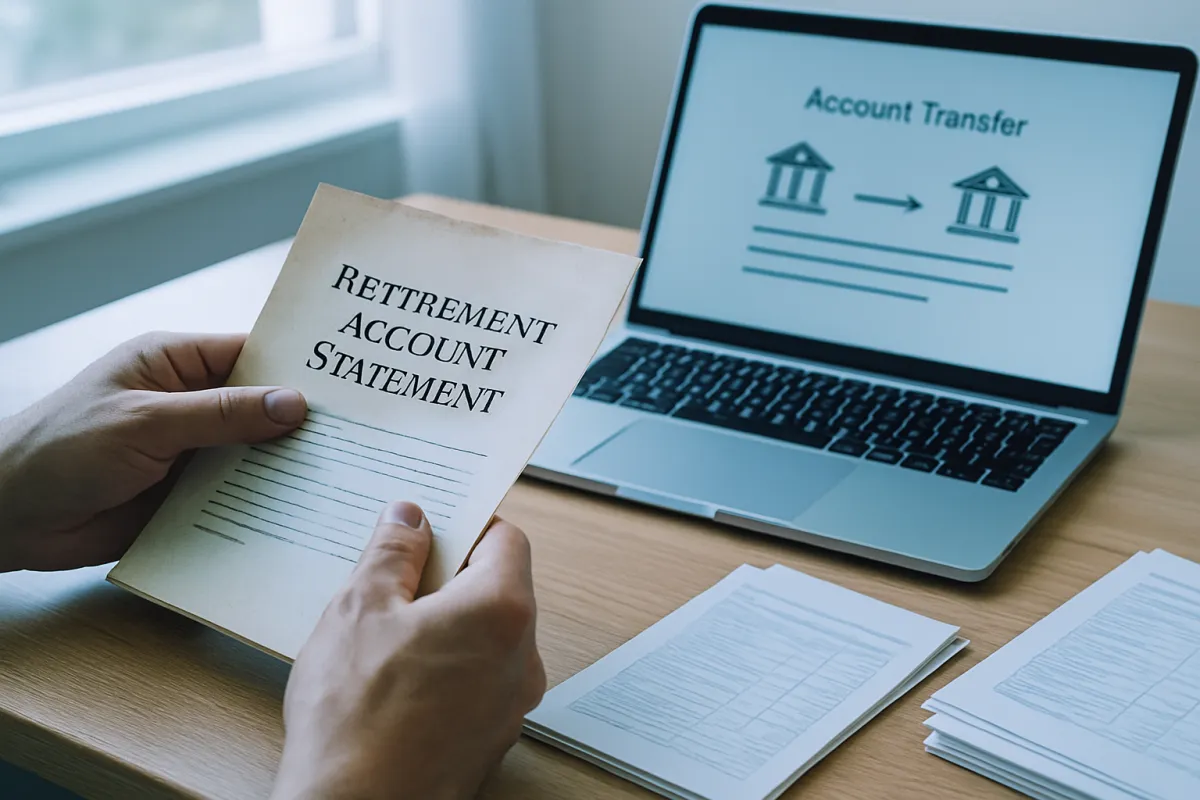
Now open the account that will receive the money, because the transfer cannot begin until there is somewhere for it to go. If you are rolling into an IRA, this is the quick part: choose a reputable, low-cost provider, select the account type that matches your money (a traditional IRA for pre-tax 401(k) dollars, a Roth IRA for Roth 401(k) dollars), and complete the online application with standard identity details. The process mirrors opening any brokerage account and is often approved immediately. If you have never opened one, our walkthrough on how to open a Roth IRA covers the mechanics step by step, and the same flow applies to a traditional IRA.
When you open the account, be explicit that it is meant to receive a rollover, because some providers offer a dedicated rollover IRA option or a simple checkbox indicating incoming rollover funds. This does not change the account in a dramatic way for most people, but it signals your intent and can keep the paperwork clean. Have your old plan’s details nearby, since the new provider often has a guided rollover tool that pre-fills the request once it knows where the money is coming from.
If you are instead rolling into your new employer’s 401(k), you may not open anything new at all; you already have that account, and the step becomes contacting the plan administrator to confirm it accepts incoming rollovers and to get the exact instructions for how the old plan should send the money. Ask specifically how the incoming check or transfer should be labeled, because that detail matters in the next step. Watch out: leave the receiving account empty and ready rather than trying to time contributions around the rollover, and double-check that the account tax type matches the money you are moving, since a mismatch is what accidentally turns a clean transfer into a taxable conversion.
Step 4: Request a direct rollover
This is the step that determines whether your rollover is effortless or expensive, so slow down here. Contact your old 401(k) plan administrator and request a direct rollover, also called a trustee-to-trustee transfer, in which the money moves straight from the old plan to your new account without ever passing through your hands. In a direct rollover there is no taxable distribution, no mandatory withholding, and no deadline you can miss, because you are never holding the money. If the plan sends a check, ask that it be made payable to the receiving institution for your benefit, not to you personally, which keeps it a direct rollover even when a paper check is involved.
Understand what you are avoiding, because the alternative is a well-known trap. In an indirect rollover, the plan sends the money to you, and you then have a limited window, commonly cited as 60 days, to deposit it into the new account yourself. Two things bite you on that path. First, a pre-tax distribution paid to you is generally subject to mandatory withholding, commonly cited as 20 percent, which the plan sends to the tax authorities. Second, to complete a full rollover you must replace that withheld amount from your own pocket when you redeposit, or the withheld portion counts as a taxed, potentially penalized distribution. Miss the 60-day deadline entirely and the whole balance can become taxable.
Put concretely with illustrative numbers, an indirect rollover of a 50,000 dollar pre-tax balance would arrive as roughly 40,000 dollars in your hand, with 10,000 dollars withheld, and you would need to come up with that missing 10,000 dollars from savings to redeposit the full 50,000 dollars within the window, later reconciling the withholding at tax time. That is a needless cash-flow squeeze and a real risk of error. Watch out: always use the word “direct,” confirm the check is payable to the institution rather than to you, and if a check ever does land in your hands by mistake, act immediately and confirm the current deadline. The direct route removes all of this by design.

Step 5: Choose your investments once it lands
When the money arrives in the new account, it almost always lands as cash, and cash does nothing. This is the quiet mistake that undoes an otherwise perfect rollover: people complete the transfer, feel finished, and leave the balance sitting uninvested for months or years, missing exactly the growth the account exists to capture. Rolling the money over is not the finish line; investing it is. Once the balance posts, actively choose what to hold, because until you place a buy order the money is just parked.
For most people the sensible starting points are broad, low-cost funds: a total-market or broad index fund that spreads your money across a large number of companies at once, or a target-date fund that holds a diversified mix and automatically shifts toward conservative holdings as a chosen retirement year approaches. Both aim for diversification, meaning you are not betting the account on any single company, and both tend to keep fees low, which matters far more over decades than any clever stock pick. A target-date fund adds a hands-off quality, since it manages the mix for you.
To make the choice, open the receiving account’s fund menu, note the expense ratio of your candidates (lower is generally better), and confirm the fund matches your timeline and your comfort with market swings. A longer horizon can usually accommodate more ups and downs because there is more time to recover, while money you might need sooner calls for more caution. Enter the amount and place the order, and your cash becomes an investment. Watch out: none of this is a recommendation of a specific fund, and diversification reduces but does not eliminate risk. The goal at this stage is a sensible, diversified, low-cost holding you can leave alone, not a hot pick, and if you want guidance built around your situation, that is a fair question for a qualified professional. Run your balance and horizon through the calculator to see what leaving it invested could become.

Step 6: Confirm it posted and handle the tax paperwork
The last step is verification and record-keeping, which is easy to skip and occasionally the thing that saves you from a headache. Once you have requested the rollover, follow it to completion: confirm the old plan sent the money, confirm the new account received the full amount, and confirm you actually invested it in Step 5. Rollovers can take anywhere from a few days to a few weeks, and checks can get delayed or lost, so do not assume it finished. A quick login to both accounts, or a short call, closes the loop. Keep a note of the amounts and dates in case anything needs reconciling later.
At tax time, expect paperwork even though a proper rollover is not taxable. Your old plan generally issues a form reporting the distribution (commonly a 1099-R), and a direct rollover is typically coded to indicate the money went into another retirement account rather than to you. The receiving institution generally reports the incoming rollover as well. Your job is to make sure your tax return reflects that this was a rollover, not a taxable withdrawal, so the reported distribution does not accidentally get treated as income. The specific forms, codes, and lines are general here and can change, so confirm the current treatment or lean on tax software or a professional.
If any part of your move was a deliberate Roth conversion, that portion is taxable and gets reported differently, so keep those figures separate from the non-taxable rollover. Watch out: the single biggest paperwork error is letting a correctly executed rollover appear as a taxable distribution because the forms were not reconciled, which can generate a tax notice for money you never actually took. A few minutes of attention when the forms arrive prevents that. Save every confirmation, and treat the paperwork as the receipt that proves the whole thing was done right.
Your 401(k) options, ranked
It helps to see the four options side by side on the same balance, because the ranking is not close once you measure what actually keeps working for your retirement. The chart below is illustrative. It takes a 50,000 dollar old 401(k) and shows how many of those dollars stay invested and tax-advantaged under each choice. The three rollover-style paths all preserve the full balance; only cashing out before retirement age carves a large piece off the top for tax and penalty.
Dollars still working for retirement, by option
Illustrative 50,000 dollar old 401(k). Cash-out assumes an under-retirement-age distribution at an illustrative 22 percent tax plus a commonly cited 10 percent penalty.
The first three options keep every dollar sheltered and compounding; the ranking among them is about control, fees, and convenience, not lost money. Cashing out is the only choice that permanently destroys value, which is why it sits last.
The takeaway is not that the three rollover paths are identical. Choosing among them still matters for fees, investment choice, and how many accounts you juggle, which is what Steps 1 and 2 help you weigh. The point is that the meaningful, dollar-destroying decision is whether you keep the money sheltered at all. Get that right, and you are choosing between good and good; get it wrong by cashing out, and no clever fund choice later can recover what tax, penalty, and forfeited growth take. Test your own balance in the calculator to see the gap in your case.
IRA vs 401(k): which should hold your money
The rollover decision often reduces to a simple ira vs 401k comparison, because both keep your money tax-advantaged and the real choice is control versus convenience. An IRA you open yourself usually offers the widest investment menu and often the lowest-cost funds, plus the ability to consolidate several old accounts into one place you control. A 401(k), whether your old plan or a new employer’s, offers the simplicity of a single workplace account and sometimes access to institutional funds or plan features you value, though its menu is set by the plan rather than by you. Neither is universally better: an IRA trades employer simplicity for breadth and control, while a 401(k) trades choice for consolidation and, in some plans, stronger creditor protection or earlier penalty-free access. Weigh those trade-offs against your own priorities the same way Step 2 does, and for anything you are unsure about, especially creditor protection or access rules, ask a qualified professional.
Rollover vs cash-out: where your money goes
To see why cashing out is so costly, break a single balance into where it actually ends up. The stacked bar below is illustrative and follows the same 50,000 dollar example through a cash-out before retirement age. It splits that balance into the three pieces it becomes: the portion you keep, the portion lost to income tax, and the portion lost to the early-withdrawal penalty. A rollover, by contrast, keeps the entire bar in the first color, because 100 percent stays invested.
Where a cashed-out 50,000 dollars goes
Illustrative under-retirement-age cash-out: 22 percent income tax and a commonly cited 10 percent penalty. Shares sum to 100. A rollover keeps 100 percent invested.
The split is illustrative and your real tax rate varies, but the structure holds: cashing out under retirement age surrenders roughly a third of the balance immediately. A rollover keeps the whole bar working, which is the entire argument for it.
Even that chart understates the cost, because it only counts the immediate haircut. The 34,000 dollars kept after a cash-out is money you likely spend, while the 50,000 dollars in a rollover keeps compounding for decades. That forfeited growth, not the tax and penalty alone, is what makes cashing out the single most expensive move in this worksheet, and it is the subject of the next section. Whenever the convenience of cashing out tempts you, picture this bar and the growth it never earns.
Why cashing out costs far more than it looks
The tax and penalty are only the visible cost of cashing out; the invisible cost is everything the money would have become. That is the part people underestimate, because a 16,000 dollar hit on a 50,000 dollar balance feels painful but survivable, while the true price is measured in the account you will not have in retirement. Money left invested compounds, and compounding rewards time more than any other factor, which our walkthrough on the power of compound interest traces in detail.
Consider the illustrative arithmetic. Keep the full 50,000 dollars invested and, at an assumed 7 percent annual return over 25 years, it projects to roughly 271,000 dollars, of which about 221,000 dollars is growth you never deposited. Cash it out instead and you keep about 34,000 dollars today and grow nothing, because spent money cannot compound. The real cost of cashing out in this example is not the 16,000 dollars in tax and penalty; it is the gap between roughly 271,000 dollars and whatever the after-tax cash becomes once spent, which is often nothing at all.
That is why every rollover path beats a cash-out by a margin that grows wider every year you are from retirement. A younger saver cashing out an old account is trading a lifetime of compounding for a fraction of the balance in cash today, which is almost always a poor bargain. The rules and rates here are general and change over time, so treat the numbers as a teaching shape rather than a forecast, and confirm the current figures. Put your own balance, horizon, and assumed return into the calculator to see how large the gap is for you.
A worked example: rolling over 50,000 dollars
Make it concrete with one illustrative saver. Suppose Alex leaves a job with about 50,000 dollars in a former employer’s traditional 401(k), all pre-tax, and is well under retirement age. Step 1, Alex names the four options and immediately rules out cashing out, recognizing that a distribution would trigger income tax and the early-withdrawal penalty. Step 2, Alex chooses to roll into a traditional IRA to match the pre-tax money and gain a wider, lower-cost fund menu, deciding an IRA’s control matters more than folding it into the new employer’s plan.
Step 3, Alex opens a traditional IRA at a reputable low-cost provider, marking it as a rollover account and keeping the old plan’s details handy. Step 4 is the pivotal one: Alex calls the old plan administrator and requests a direct, trustee-to-trustee rollover, confirming that any check will be made payable to the new institution for Alex’s benefit rather than to Alex personally. Because it is a direct rollover, there is no 20 percent withholding and no 60-day clock. Step 5, once the roughly 50,000 dollars posts as cash, Alex buys a broad, low-cost index fund so the money is actually invested. Step 6, Alex confirms both accounts reflect the full amount and files the 1099-R at tax time, coded as a non-taxable rollover.
Now compare the paths with illustrative math. By rolling, Alex keeps the full 50,000 dollars, which at an assumed 7 percent return over 25 years projects to roughly 271,000 dollars. Had Alex cashed out instead, an illustrative 22 percent tax (about 11,000 dollars) and a 10 percent penalty (about 5,000 dollars) would have left roughly 34,000 dollars, with no future growth on spent money. Alex did nothing exotic: ruled out cashing out, matched the tax type, opened the account, insisted on a direct rollover, invested the cash, and reconciled the paperwork. None of these figures is a promise, and real returns and tax rates vary, so treat them as a shape rather than a forecast. Build your version in the calculator.
Common mistakes to avoid
A handful of rollover errors show up often enough to name directly, because avoiding them is worth more than any fund selection.
- Cashing out an old account. The costliest mistake by far. Taking the money as a distribution before retirement age generally triggers income tax plus an early-withdrawal penalty and forfeits every dollar of future growth. Roll it instead unless you are in genuine hardship.
- Taking an indirect rollover by accident. Letting the plan send the money to you invites mandatory withholding (commonly cited as 20 percent) and the 60-day redeposit deadline. Always ask for a direct, trustee-to-trustee rollover and confirm any check is payable to the receiving institution.
- Missing the 60-day window. If you do end up holding a distribution, redepositing late can turn the whole balance into a taxable, penalized withdrawal. Act immediately and confirm the current deadline.
- Leaving the money in cash. A completed rollover that sits uninvested misses the growth the account exists for. After the balance posts, actively buy a diversified, low-cost fund.
- Forgetting old accounts. Scattered 401(k)s from past jobs are easy to lose track of. List every former account and deal with each, since a neglected account can also be force-distributed if the balance is small.
- Accidentally converting to Roth. Moving pre-tax money into a Roth account is a taxable conversion. Match tax types unless you specifically intend, and understand, a conversion.
None of these requires sophistication to avoid, only attention to the method and one follow-through step after the money lands.
Troubleshooting and edge cases
A few situations come up often enough to address directly, in plain terms.
What if I have several old 401(k)s? Roll them one at a time into a single IRA, which is one of the strongest reasons to choose an IRA as the destination: it consolidates scattered accounts into one place you control and monitor. Handle each rollover with the same direct, trustee-to-trustee method, and keep a checklist so none is forgotten. Consolidating also simplifies your investing and your paperwork for years afterward.
What if my old account holds my former employer’s stock? Company stock inside a 401(k) can involve a specialized tax treatment sometimes referred to as net unrealized appreciation, which in some cases lets the appreciation be taxed differently than ordinary income. It is a genuinely technical area with real trade-offs, and rolling the stock into an IRA can forfeit that potential treatment. Because the stakes and rules are nuanced and depend on your numbers, this is a clear case to review with a tax professional before you move employer stock, rather than defaulting to a standard rollover.
What if I have a Roth 401(k)? Roth 401(k) money generally rolls into a Roth IRA (or a new Roth 401(k)) while staying in the after-tax, tax-free-growth world, with no tax on the rollover. Keep Roth with Roth, just as you keep pre-tax with pre-tax. One wrinkle is how the Roth IRA’s five-year clock interacts with your Roth 401(k) history, which affects when earnings are tax-free, so confirm how the holding periods carry over for your accounts.
What if my balance is small and the plan forces it out? Plans commonly can push very small accounts out after you leave. Depending on the amount, you may receive a check or the plan may move the money into an IRA on your behalf, and a check sent to you can start the same 60-day clock and withholding issues that make indirect rollovers risky. Deal with small old accounts promptly, and if a check arrives, move quickly to redeposit it into a qualifying account.
Your 401(k) rollover checklist
Turn the six steps into a sequence you can act on, mostly in one sitting plus some waiting.
- Rule out cashing out: confirm you will keep the money sheltered rather than taking a taxable, penalized distribution.
- Choose the destination: pick an IRA or your new employer’s 401(k), matching pre-tax money to a traditional account and Roth money to a Roth account.
- Open the receiving account: open the matching IRA at a low-cost provider, or confirm your new plan accepts incoming rollovers, and gather the exact instructions.
- Request a direct rollover: call the old plan and ask for a direct, trustee-to-trustee transfer, with any check payable to the receiving institution, not to you.
- Invest the cash: once the balance posts, buy a diversified, low-cost fund so the money is working, not parked.
- Confirm and file: verify both accounts show the full amount, and reconcile the 1099-R at tax time so a proper rollover is not mistaken for taxable income.
Run your own balance, years to retirement, and assumed return through the calculator to turn this checklist into a specific projection.
The bottom line
Rolling over a 401(k) is a short, ordered task whose entire risk lives in the method. Rule out cashing out, choose a destination that matches your money’s tax type, open the receiving account, request a direct trustee-to-trustee rollover so the money never touches your hands, invest the cash once it lands, and reconcile the paperwork at tax time. Do it that way and the balance stays sheltered, keeps compounding, and never generates a tax bill; do it carelessly, by cashing out or fumbling an indirect rollover, and you can surrender roughly a third of the money plus the decades of growth it would have earned. Every figure here is a teaching illustration rather than a forecast, and tax rules, rates, and deadlines change over time, so confirm the current figures and, for decisions specific to your situation, especially conversions and employer stock, talk to a qualified professional. The steps are simple, the stakes are long-term, and the safe path is always the direct one. Put your numbers into the calculator and see where you would stand.
This worksheet is educational only and is not financial, tax, or investment advice. The rules governing 401(k) rollovers, including the early-withdrawal penalty, mandatory withholding on distributions paid to you, the 60-day redeposit window, small-balance provisions, Roth holding periods, and the tax treatment of conversions and employer stock, are set by law and administered by the IRS and plan sponsors, and they change over time, so read every dollar figure, tax rate, and projected balance here as an illustration meant to show the shape of the math, never as a current figure or a promise. The 50,000 dollar balance, 22 percent tax rate, 10 percent penalty, 7 percent return, and multi-decade projections are simplified for teaching and assume steady returns that real markets will not deliver exactly. Investing involves risk, including the possible loss of principal, and diversification does not guarantee a profit. Before choosing a destination account, requesting a rollover, converting to Roth, moving employer stock, or handling a distribution check, confirm the current rules and consult a qualified professional, such as a fee-only fiduciary planner and a tax advisor, for guidance built around your circumstances.
Frequently asked questions
What does it mean to roll over a 401(k)?
Rolling over a 401(k) means moving the money out of a former employer's retirement plan and into another tax-advantaged account, most often an individual retirement account (IRA) or a new employer's 401(k), without triggering taxes or an early-withdrawal penalty. The point is to keep the money inside the retirement tax shelter while giving yourself more control, lower fees, or a single consolidated account. A rollover is not a withdrawal: done correctly, the balance never counts as taxable income for the year. The mechanics matter a great deal, because the difference between a direct rollover and an indirect one can be the difference between a clean transfer and an accidental tax bill, which is what this worksheet is built to help you avoid.
Will I pay taxes or a penalty when I roll over a 401(k)?
A properly executed rollover between two accounts of the same tax type, for example a traditional 401(k) into a traditional IRA, generally is not taxed and does not trigger the early-withdrawal penalty, because the money never leaves the tax-advantaged system. The penalty and the income tax apply when you actually take the money out and keep it, which is a cash-out, not a rollover. One exception worth understanding is converting pre-tax 401(k) money into a Roth account, which is a taxable event by design because you are moving from before-tax to after-tax treatment. Tax rules change and depend on your situation, so confirm the current rules and consider a tax professional before you convert.
What is the difference between a direct and an indirect rollover?
In a direct rollover, sometimes called a trustee-to-trustee transfer, the money moves straight from your old plan to the new account without ever passing through your hands, which is the clean and safe path. In an indirect rollover, the plan sends the money to you first, and you then have a limited window, commonly described as 60 days, to deposit it into the new account yourself. The indirect route carries two traps: the plan is generally required to withhold a portion (commonly cited as 20 percent) of a pre-tax distribution for taxes, and if you miss the deadline the whole amount can become a taxable distribution. Because of those traps, a direct rollover is almost always the better choice, and it is the method this worksheet centers on.
How long do I have to complete a 401(k) rollover?
With a direct rollover, there is effectively no clock for you to worry about, because the institutions move the money between themselves and you are not holding it. With an indirect rollover, where a check is made out to you, the commonly cited window to redeposit the funds into a qualifying account is 60 days from when you receive the distribution, and missing it can turn the entire balance into a taxable, potentially penalized withdrawal. This is one of the strongest reasons to request a direct rollover instead. If you ever find yourself holding a distribution check by mistake, act quickly and confirm the current deadline and any limited relief options, ideally with a tax professional.
Should I roll my 401(k) into an IRA or into my new employer's plan?
Both keep the money tax-advantaged, and the right choice depends on what you value. Rolling into an IRA usually gives you the widest investment menu and often lower-cost fund options, plus the convenience of consolidating old accounts in one place you control. Rolling into a new employer's 401(k) can make sense if the plan has strong low-cost funds, if you value the simplicity of one workplace account, or if you want to preserve certain plan-specific features. There are nuanced differences in areas like creditor protection, access to loans, and the age at which penalty-free access begins, so weigh those against your own priorities and, for anything you are unsure about, ask a qualified professional.
What is the difference between an IRA and a 401(k)?
Both are tax-advantaged retirement accounts, but a 401(k) is offered through an employer with a menu of investments the plan chooses, while an IRA is an individual account you open yourself at a provider of your choice, typically with a far wider and often lower-cost investment selection. A 401(k) usually allows higher annual employee contributions and may come with an employer match, which an IRA does not, whereas an IRA gives you more control and easier consolidation of old balances. In a rollover the two meet directly, because you are usually deciding whether to move an old 401(k) into an IRA or into a new employer's 401(k). Contribution limits and rules for both are set by the IRS and change over time, so confirm the current figures and, for the choice that fits your situation, consult a qualified professional.
Can I leave my 401(k) with my old employer instead of rolling it over?
Often yes, if the balance is above the plan's small-balance threshold, you can generally leave the money in a former employer's plan, and it continues to grow tax-deferred. The drawbacks are practical: you may face a limited investment menu, you no longer contribute to it, and scattered old accounts are easy to lose track of or neglect over the years. If the plan has excellent, low-cost funds and you will actually keep an eye on it, leaving it can be a reasonable default. For most people, though, consolidating through a rollover reduces clutter and gives more control, which is why the rollover is worth understanding even if you ultimately choose to stay put.
What happens to a Roth 401(k) when I roll it over?
A Roth 401(k) is funded with after-tax money, so it generally rolls into a Roth IRA (or into a new employer's Roth 401(k)) while staying in the after-tax, tax-free-growth world, with no tax due on the rollover itself. Keeping Roth money with Roth money is the clean match, just as pre-tax 401(k) money pairs naturally with a traditional IRA. One detail people miss is that the Roth IRA's own five-year clock can interact with your Roth 401(k) history, which affects when earnings come out tax-free, so it is worth confirming how the holding periods carry over. Because these rules have moving parts, verify the current treatment for your accounts before you act.
What if my old 401(k) balance is small, can it be forced out?
Yes, plans commonly have a small-balance provision that lets them push very small accounts out after you leave, rather than administering them indefinitely. Depending on the amount, the plan may cut you a check or automatically move the money into an IRA set up on your behalf, and a check sent directly to you can start the same 60-day clock and withholding issues that make indirect rollovers risky. The practical takeaway is to deal with small old accounts promptly rather than ignoring them, because a forced distribution handled poorly can cost you taxes and penalties on money you never meant to spend. Confirm your former plan's threshold and, if a check arrives, move quickly to redeposit it into a qualifying account.

Hamza Hai is the editor of SumLoft. She holds an MBA and reviews the site's articles against our editorial standards, checking that every figure is labelled for what it is, that nothing is presented as verified fact without a source the reader can check, and that the writing stays useful to a non-specialist.